Bravos
Improving lingerie shopping experience for non-traditional customers
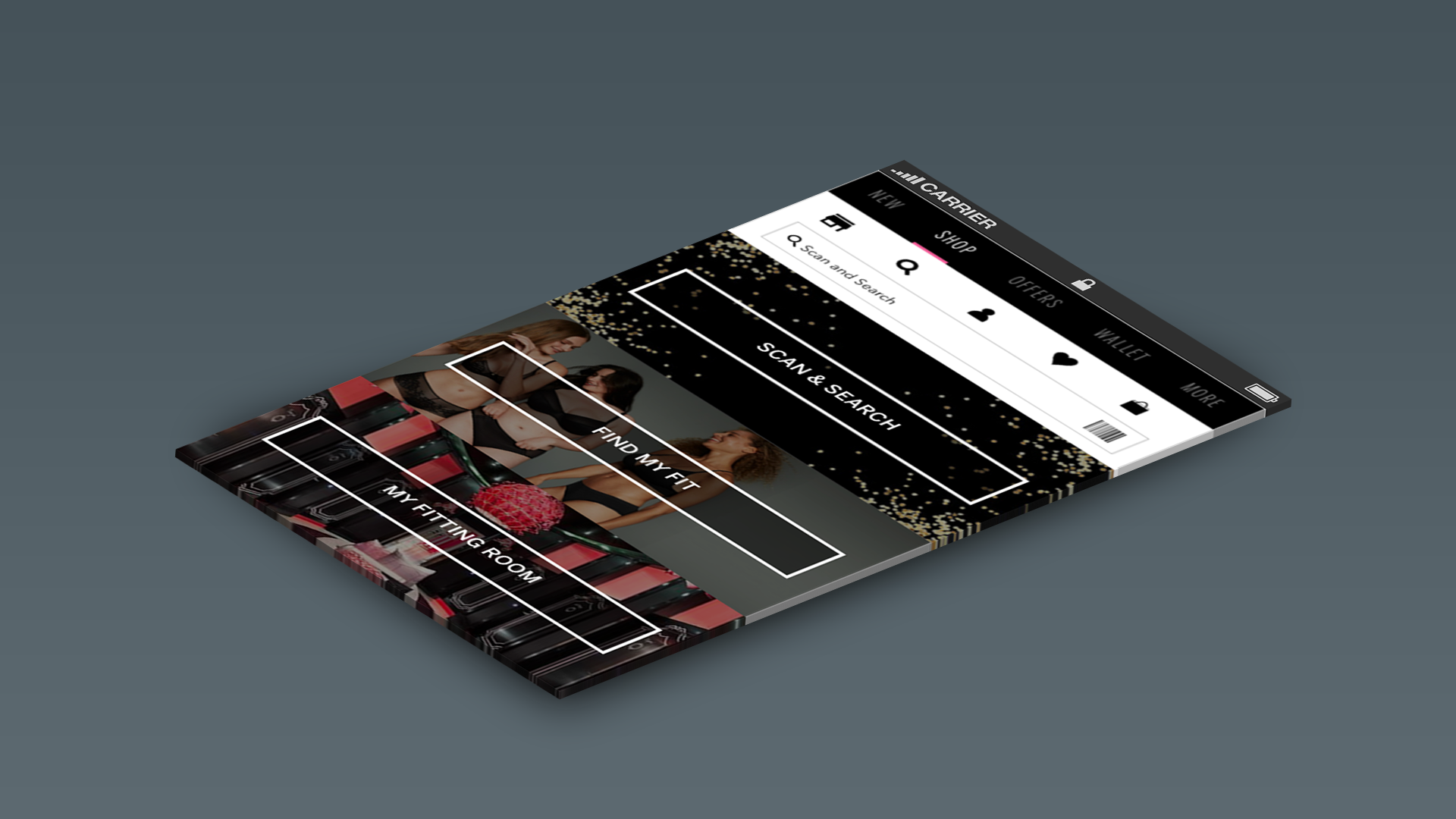
Bravos
Improving lingerie shopping experience for non-traditional customers
Role
UX Designer and User Researcher
Details
Group project (team of four), 4 months
Tools used
Sketch, Balsamiq Mockups, Invision, Illustrator
Users
User shopping for women's underwear who feel discomfort while shopping in-store
TL;DR
Shopping for women’s underwear in-store can be an uncomfortable experience, especially for non-traditional customers, so many prefer to shop online. However, true satisfaction with an underwear purchase comes from fit, feel, quality and comfort all of which can be best ascertained during an in-store shopping experience.
Bravos is a mobile application which leverages the advantages of online shopping and brings it into the in-store experience to mitigate the discomfort and creates an inclusive experience for traditional and non-traditional customers alike.
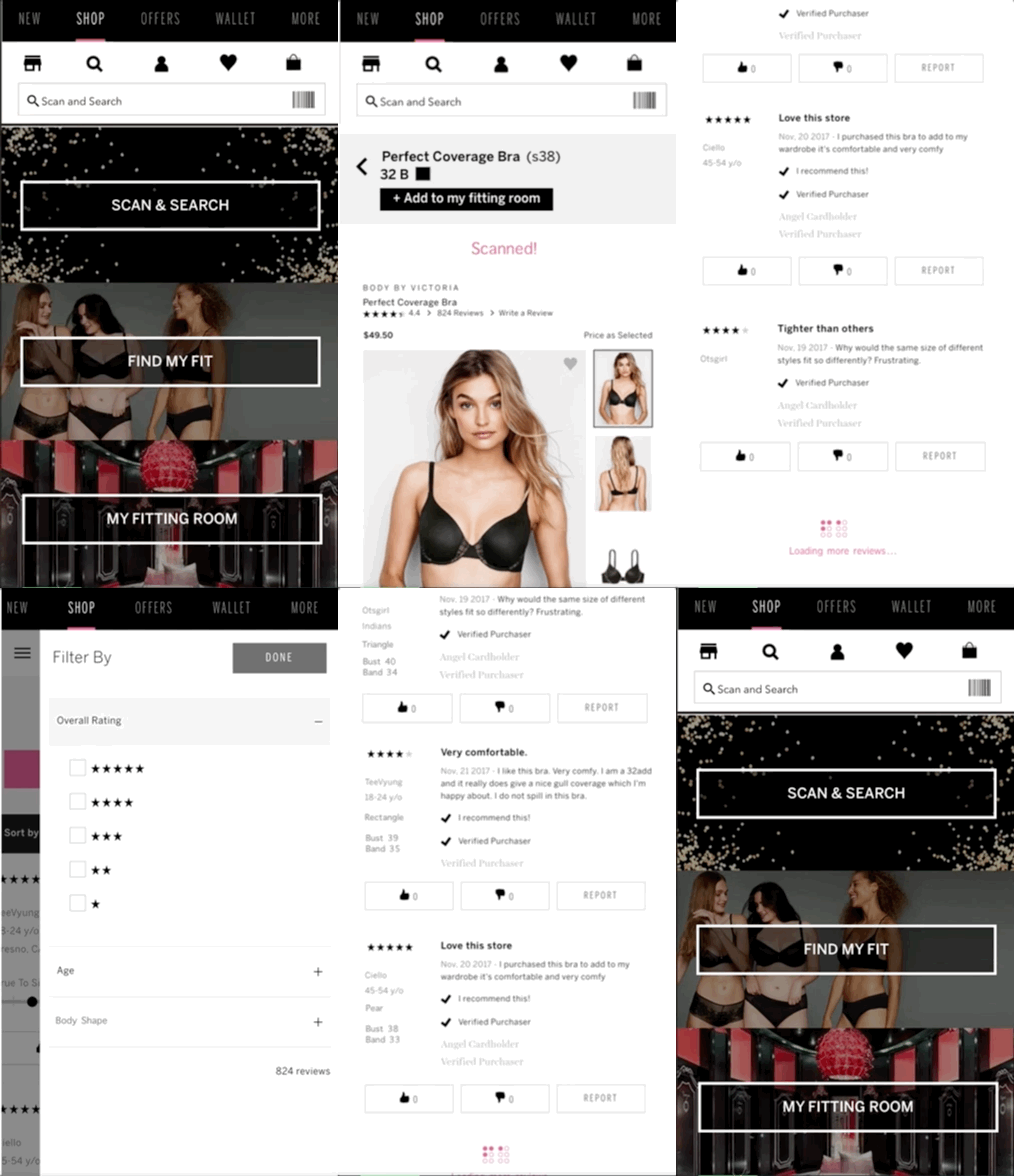
Scan. Search & Read Reviews
Users can scan a product's barcode to get more information and read reviews by other customers.
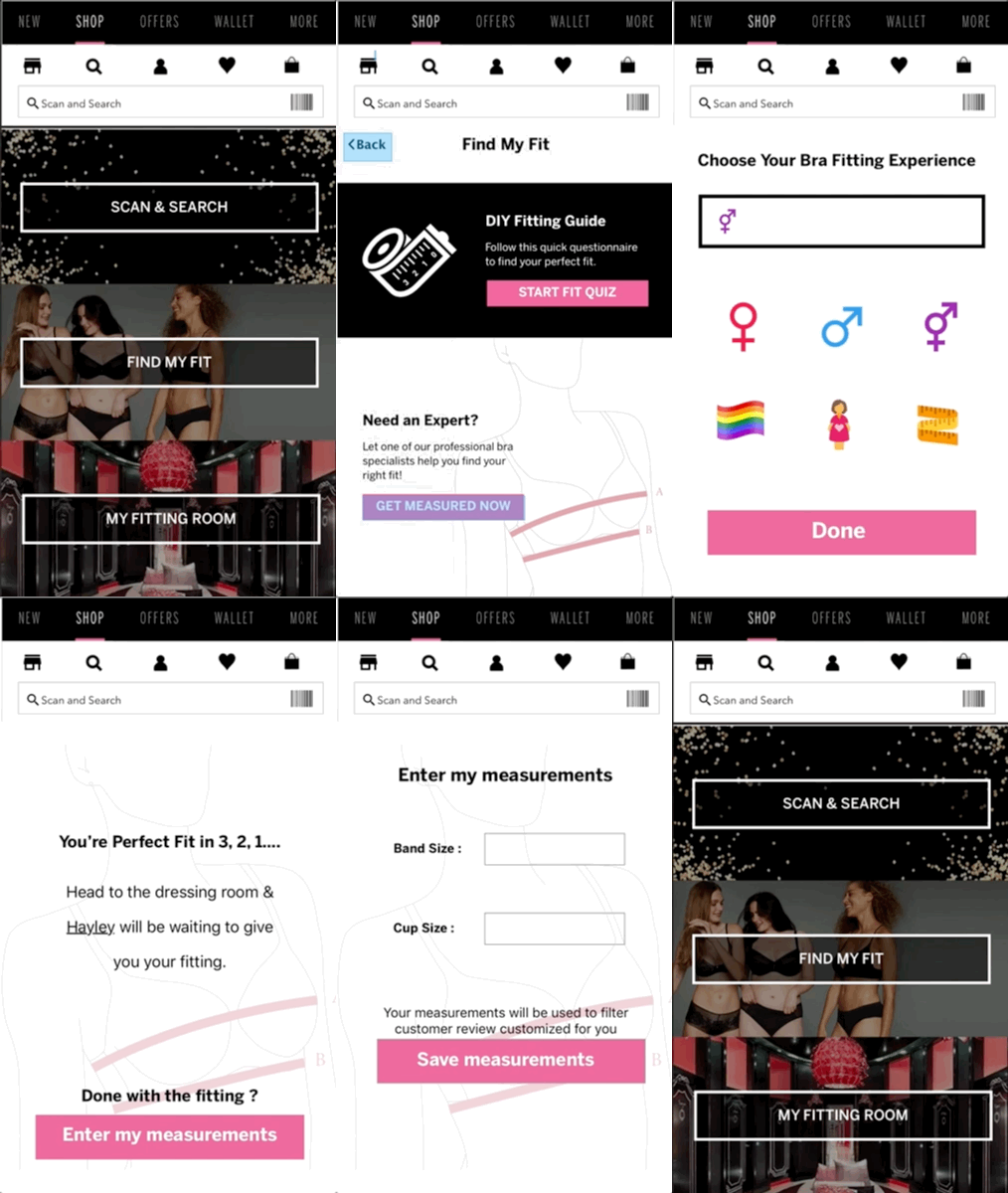
Find my Fit
Users can control their bra-fitting experience by allowing them to choose whether they want to size themselves for a fitting or get help from the Sales Associate
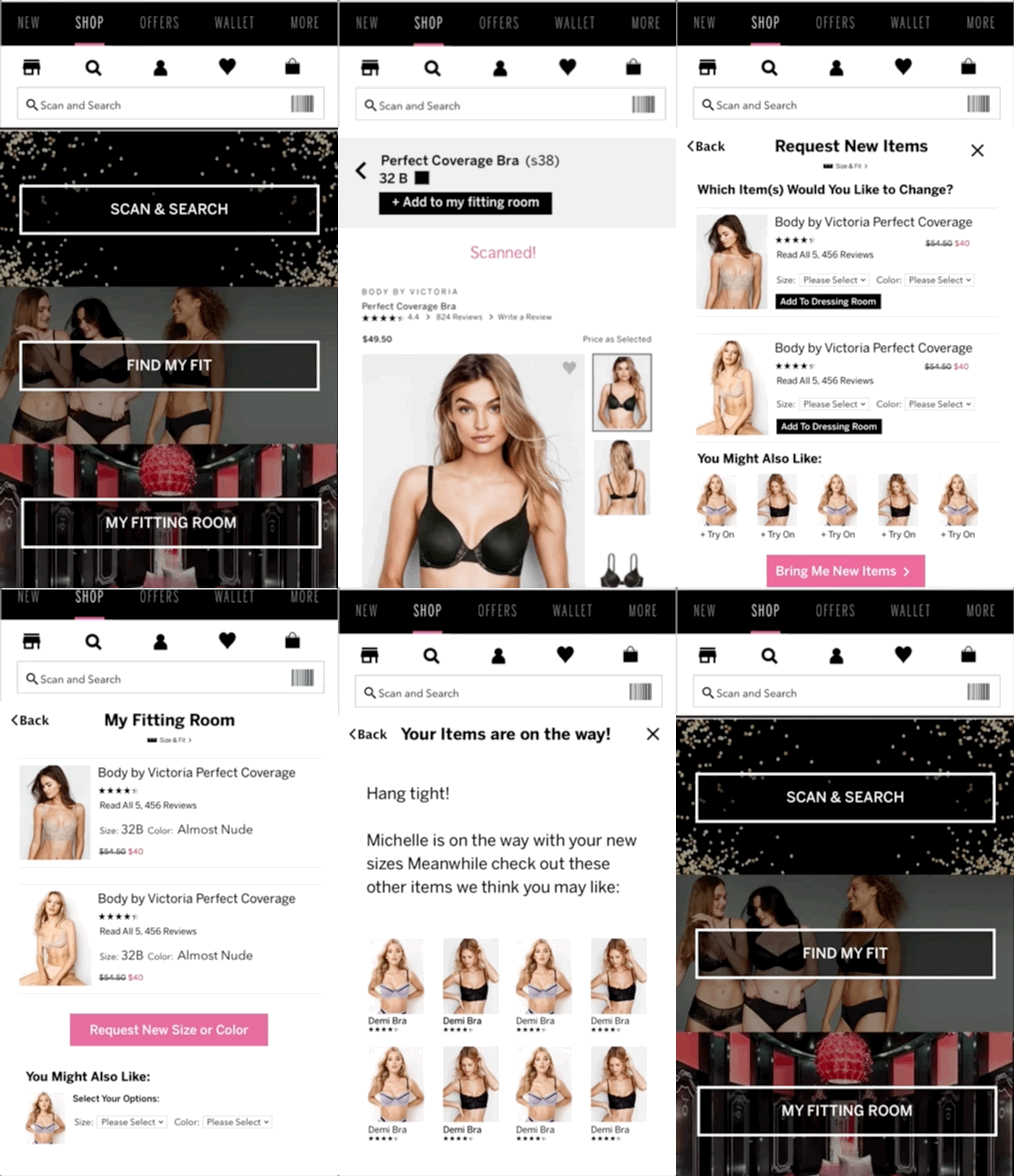
Request products from fitting room
Users can request different sized products from inside the fitting room using the app. tap.

Understanding the market
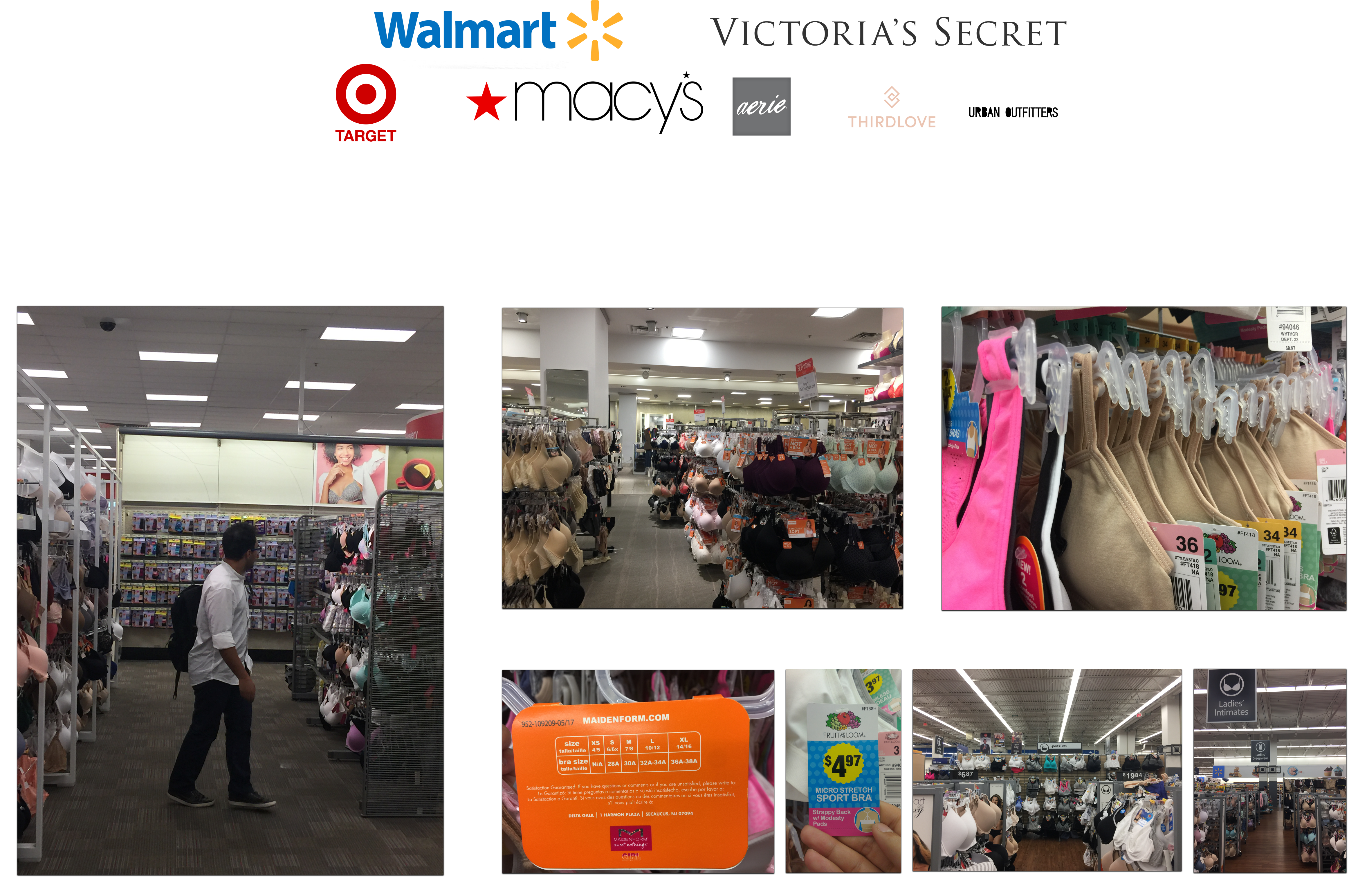
We conducted comprehensive market analysis by visiting several stores both physical and online.
We decided to focus on Victoria’s secret as it is the leader in the women’s underwear market space
By focusing on them we believed to will have access to a larger target market and potential to
make a bigger impact.
Surveys,Contextual Inquiry & Interviews followed
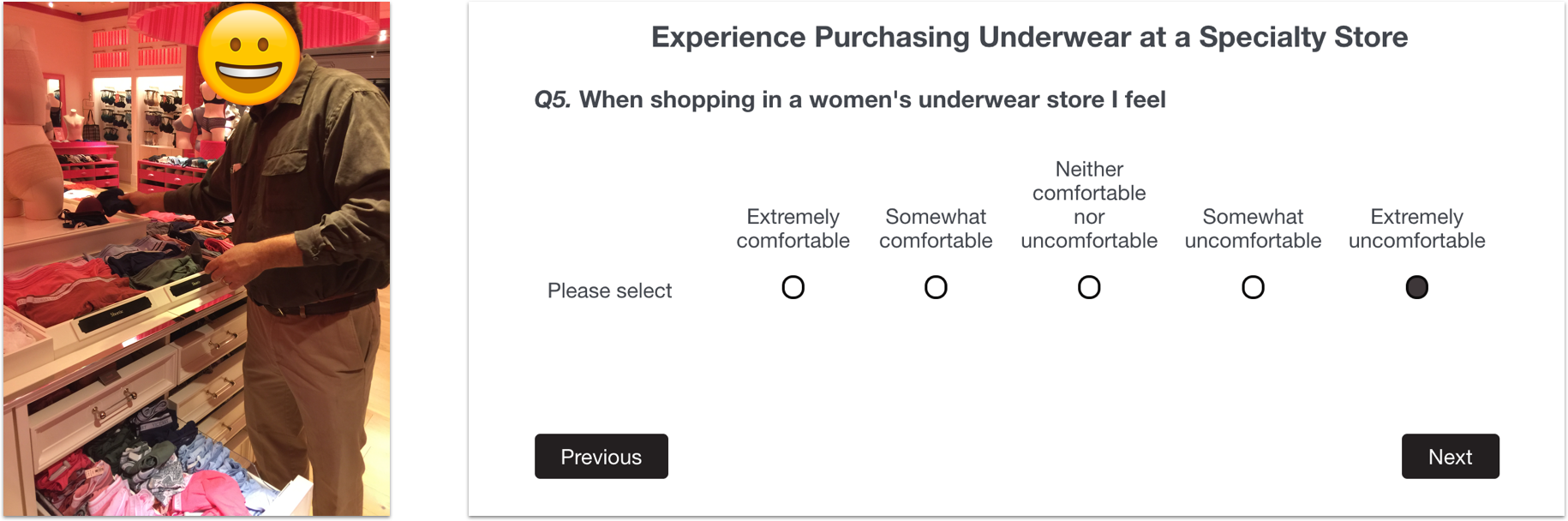
Survey : We sent out survey to reach a wider user base. Our goal was to verify our findings from our initial market analysis and observations held true for a large sample set. Also recruit participants for our in-depth contextual inquiries and interviews that would follow
Contextual Inquiry : We conducted three contextual inquiries to gain a more in-depth understanding of underwear shopping experience with Victoria’s Secret both in-store and online. Two of the contextual inquiries were conducted at two separate physical locations in Atlanta. The third contextual inquiry was conducted over a video call for the online experience.
Interviews : We conducted interviews total 4 interviews; 2 transgender women who mostly purchased underwear for themselves, one cis woman and one cis-male, who purchases underwear for his partner.

Who is the target user ?
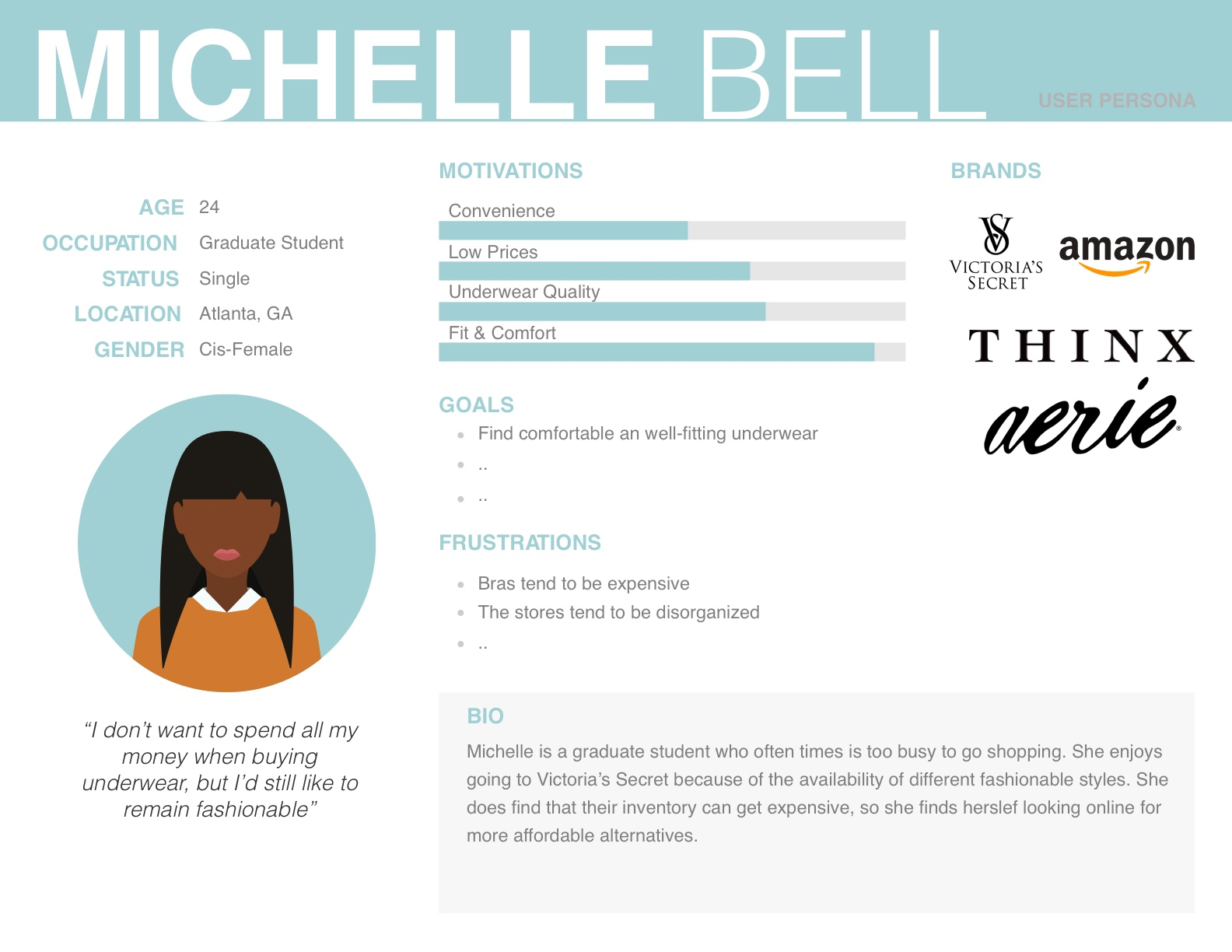
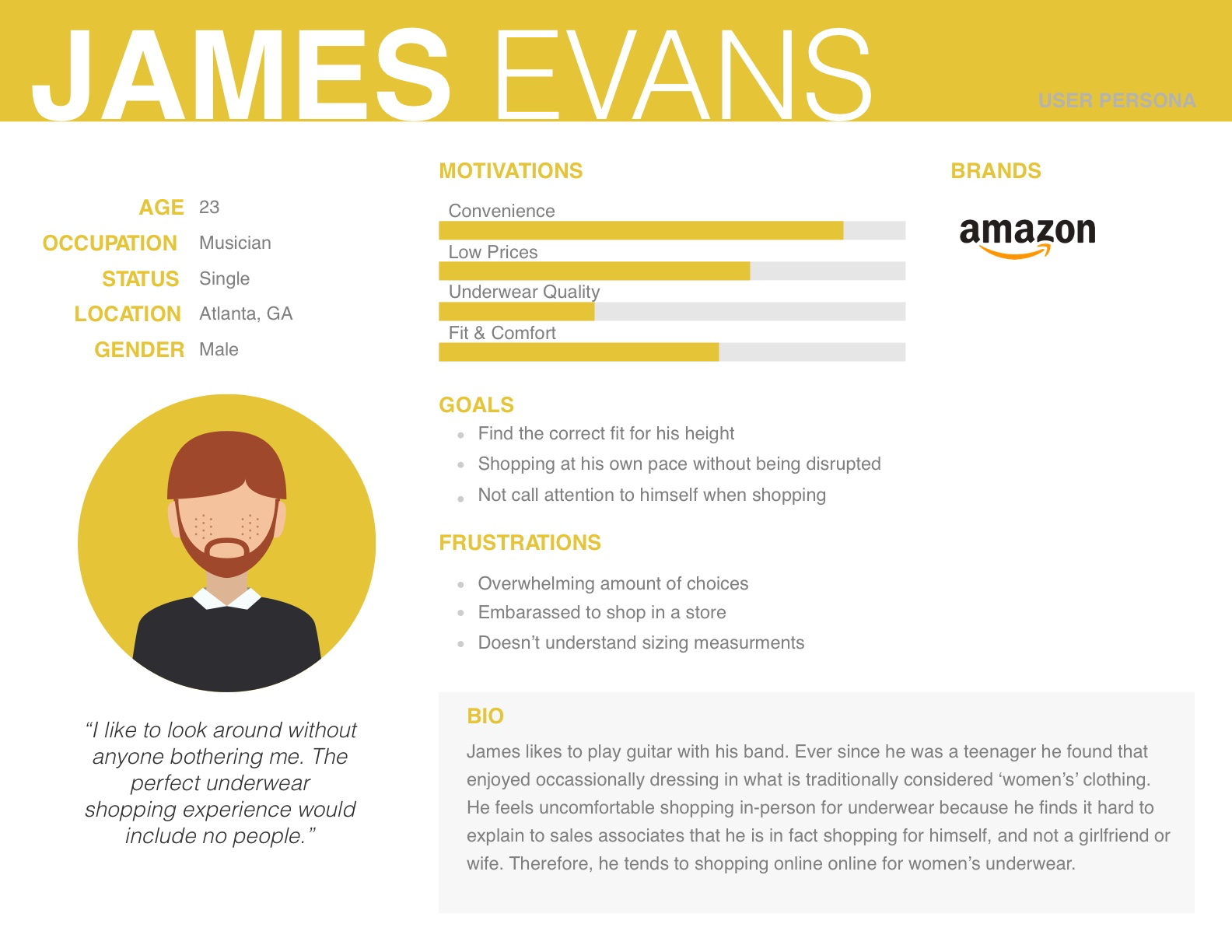
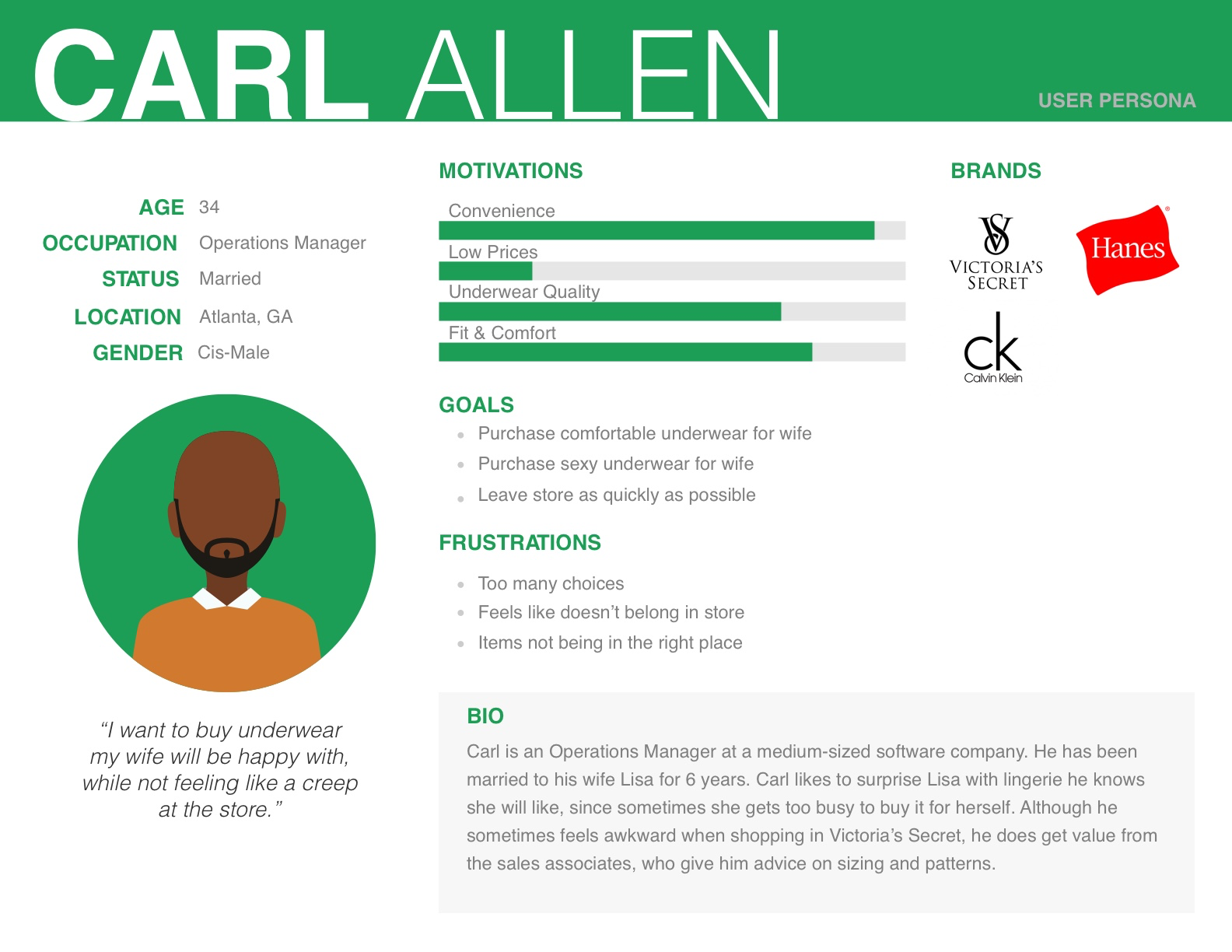
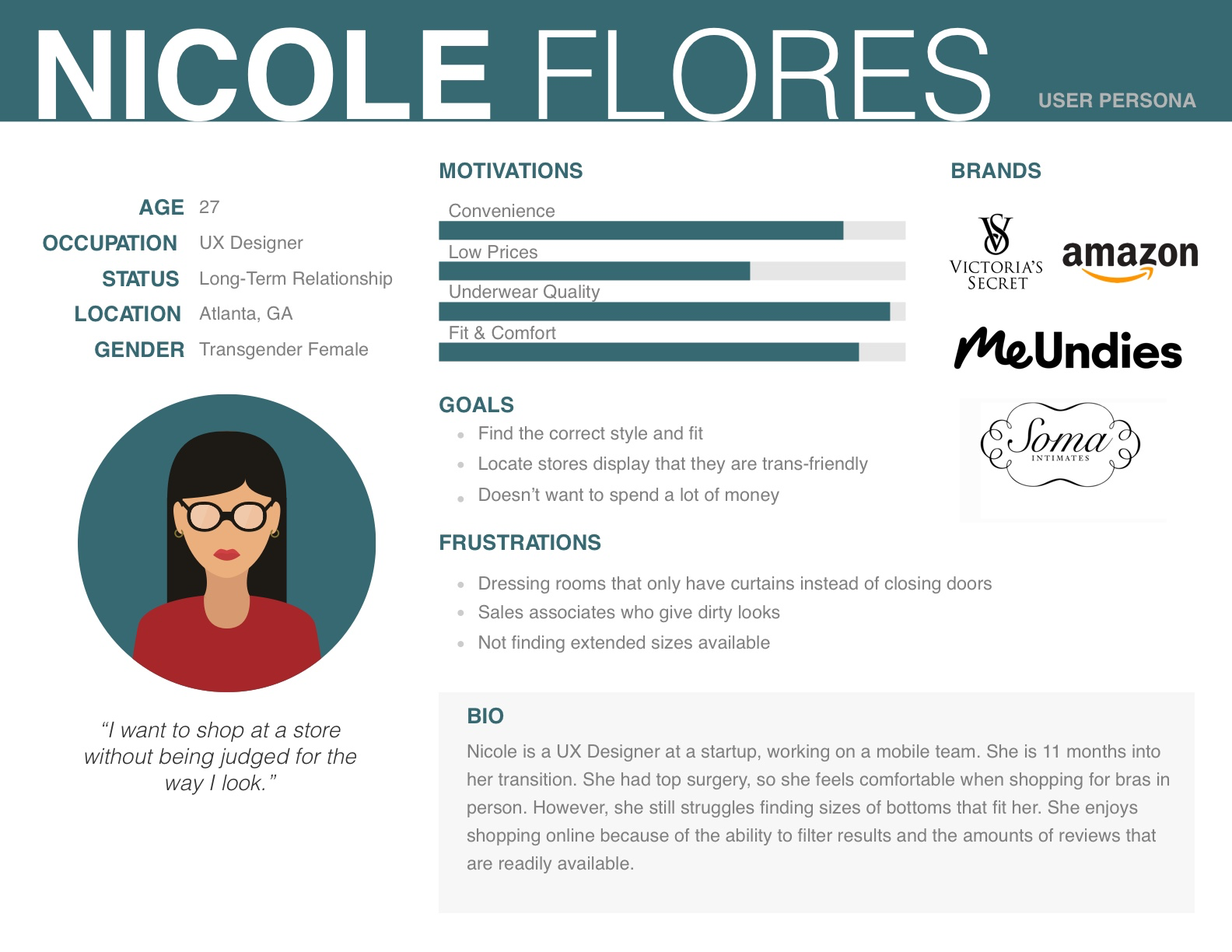
Based on the previous research, we created these user personas so to make sure that we always have an answer to who are we really designing for!
Finding the key user needs
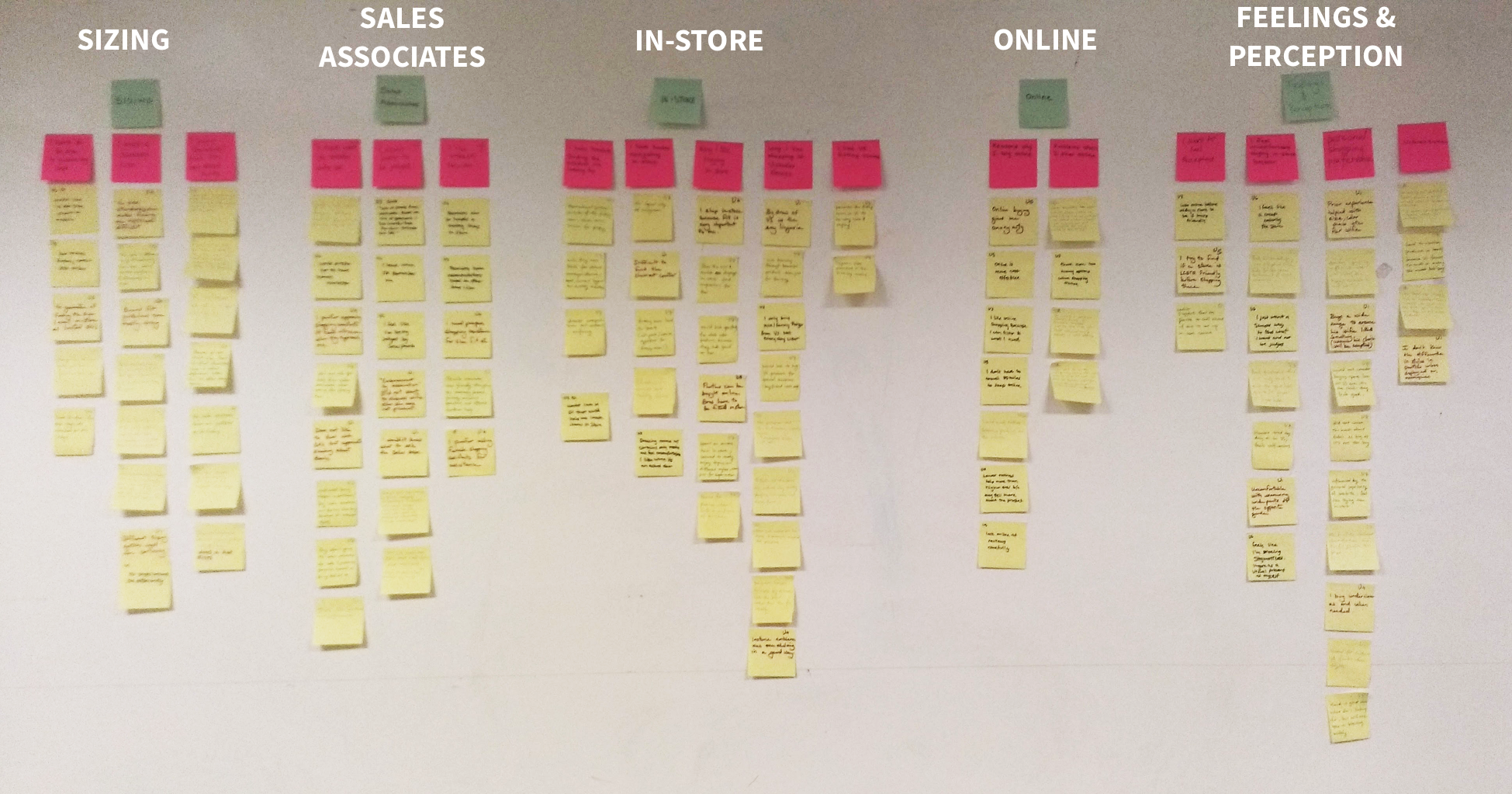
In a group session, we analyzed our notes from all the previous formative research on an affinity diagram. This helped us categorize our notes to identify key user needs.

Users want to find where the items they are looking for are located

Users want to know what an item will look like when it’s worn

Users want to control their interactions with sales associates

Users want to know what others think of the quality & fitting of the products before they purchase them
Brainstorming & Concept Sketching
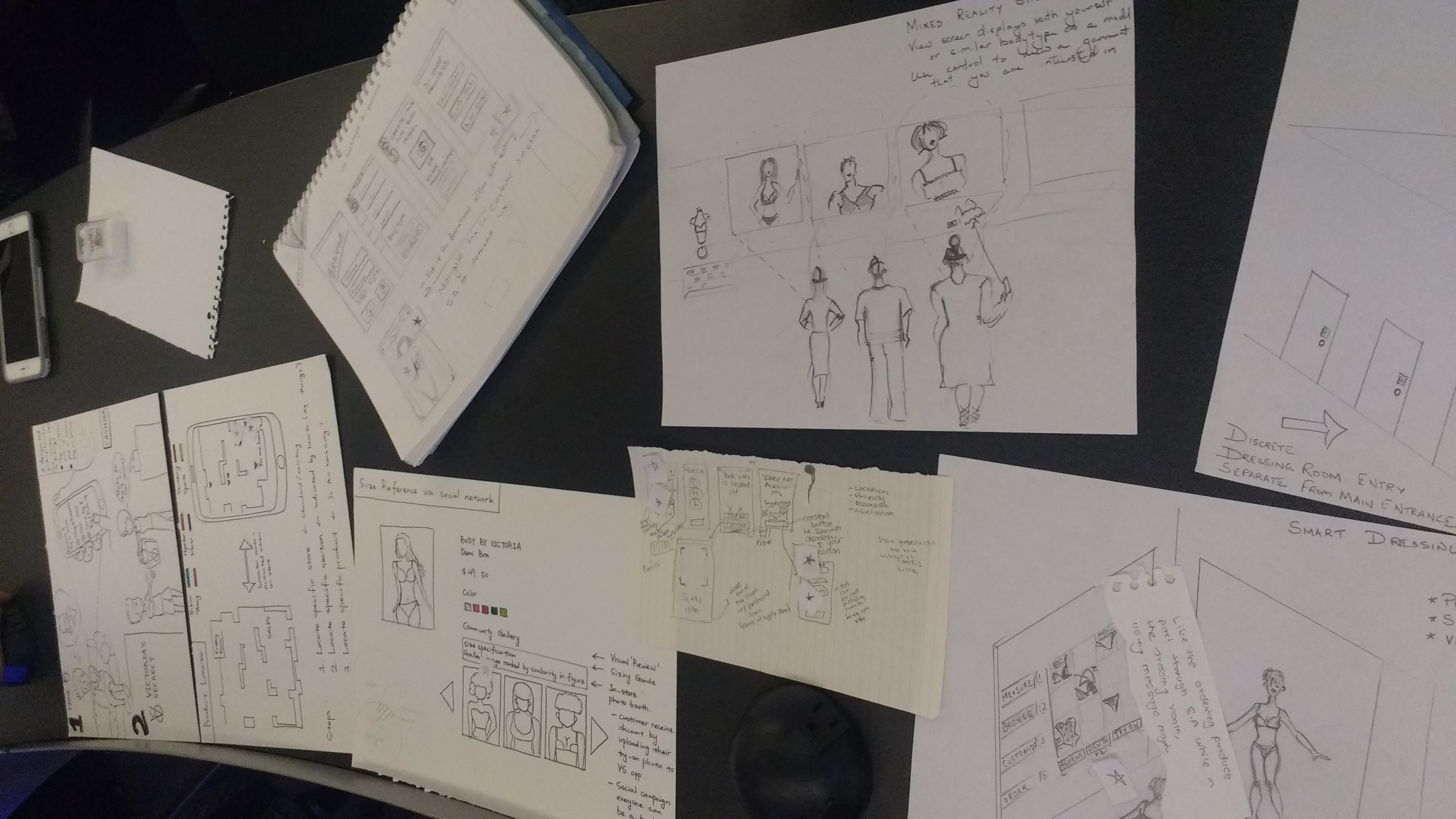
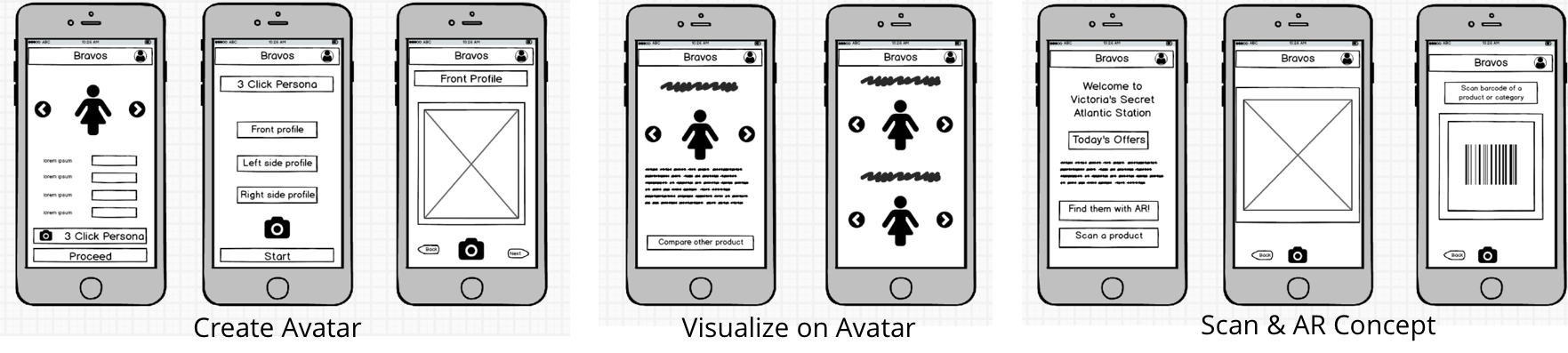
Considering the user needs, we brainstormed and came up with 4 different over-arching concepts. We each sketched and created Lo-Fi designs for one idea each and got feedback on these ideas.
Design alternatives
As narrowed down our ideas to 4 design concepts, created wireframes in Balsamiq for user feedback.
Idea #1: AvataR
Idea #2: Self-Service Shopping
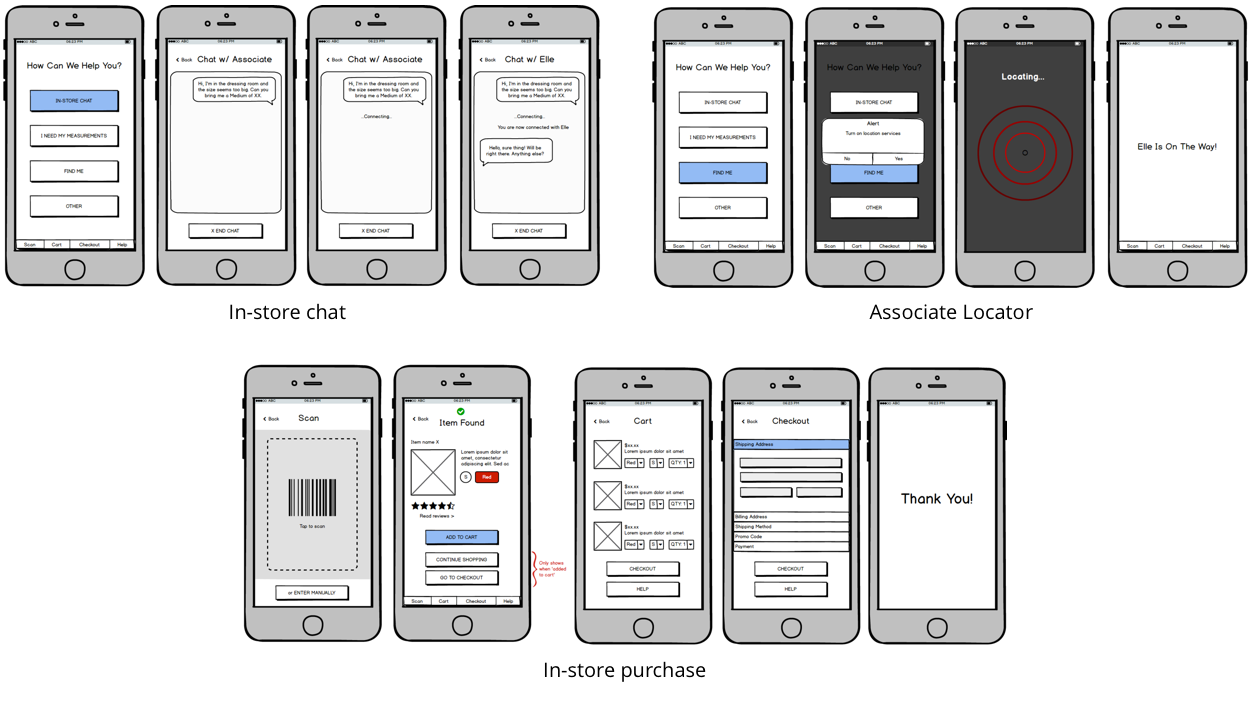
Idea #3: Social Bra
Idea #4: Smart Mirror

Concept Feedback & Feature Selection
To evaluate the features represented in the four initial concepts, we conducted 3 concept feedback sessions with interviewees from our previous phase of research, as a way to directly examine how our proposed features answer to user requirements.
The number of features that received positive feedbacks was more than we could have in a single application as it would increase the complexity of the system and could potentially affect the usability of the app. To make an informed decision on which features to keep in the wireframe, we conducted a card sorting activity.
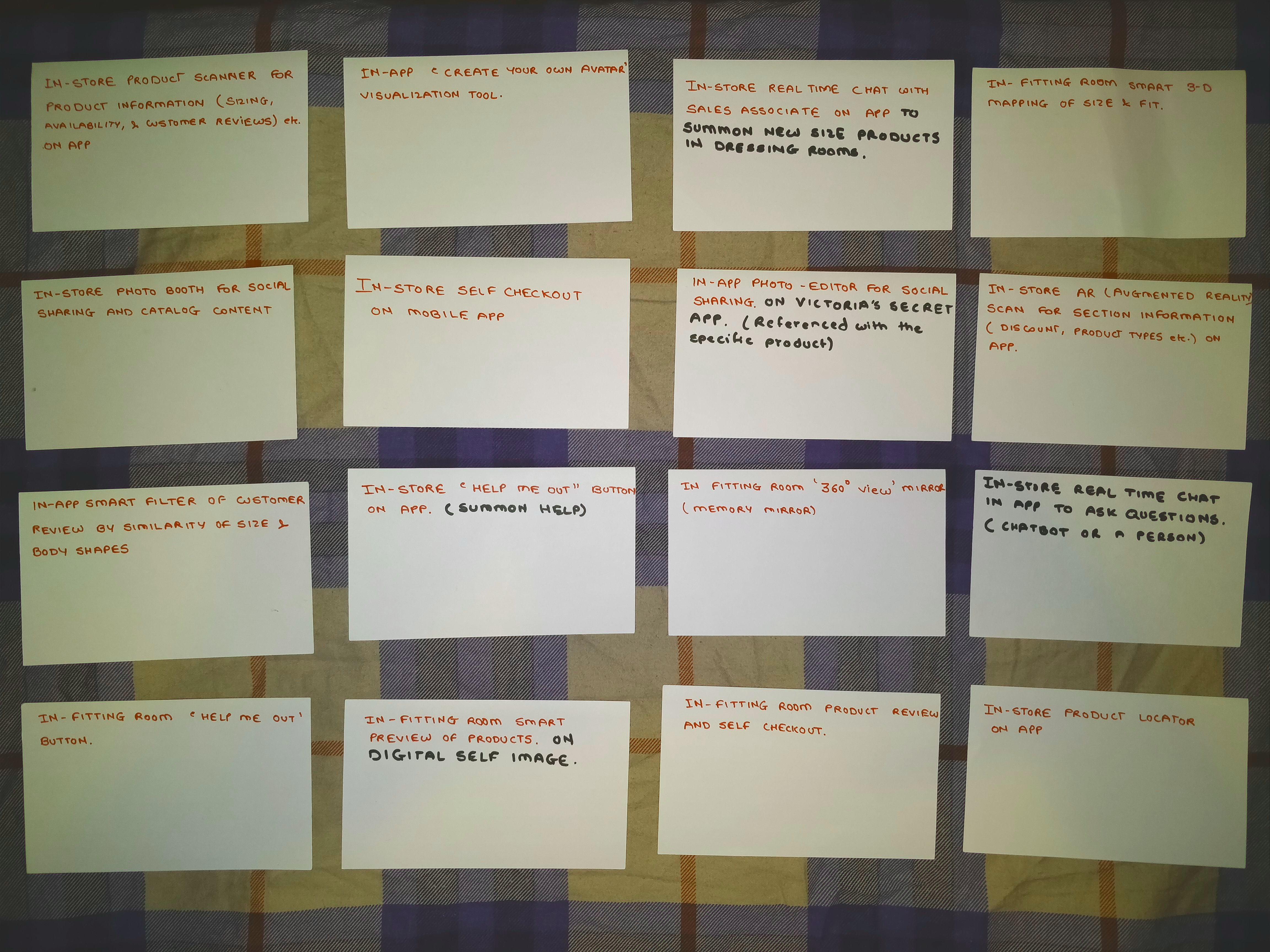
Feature cards
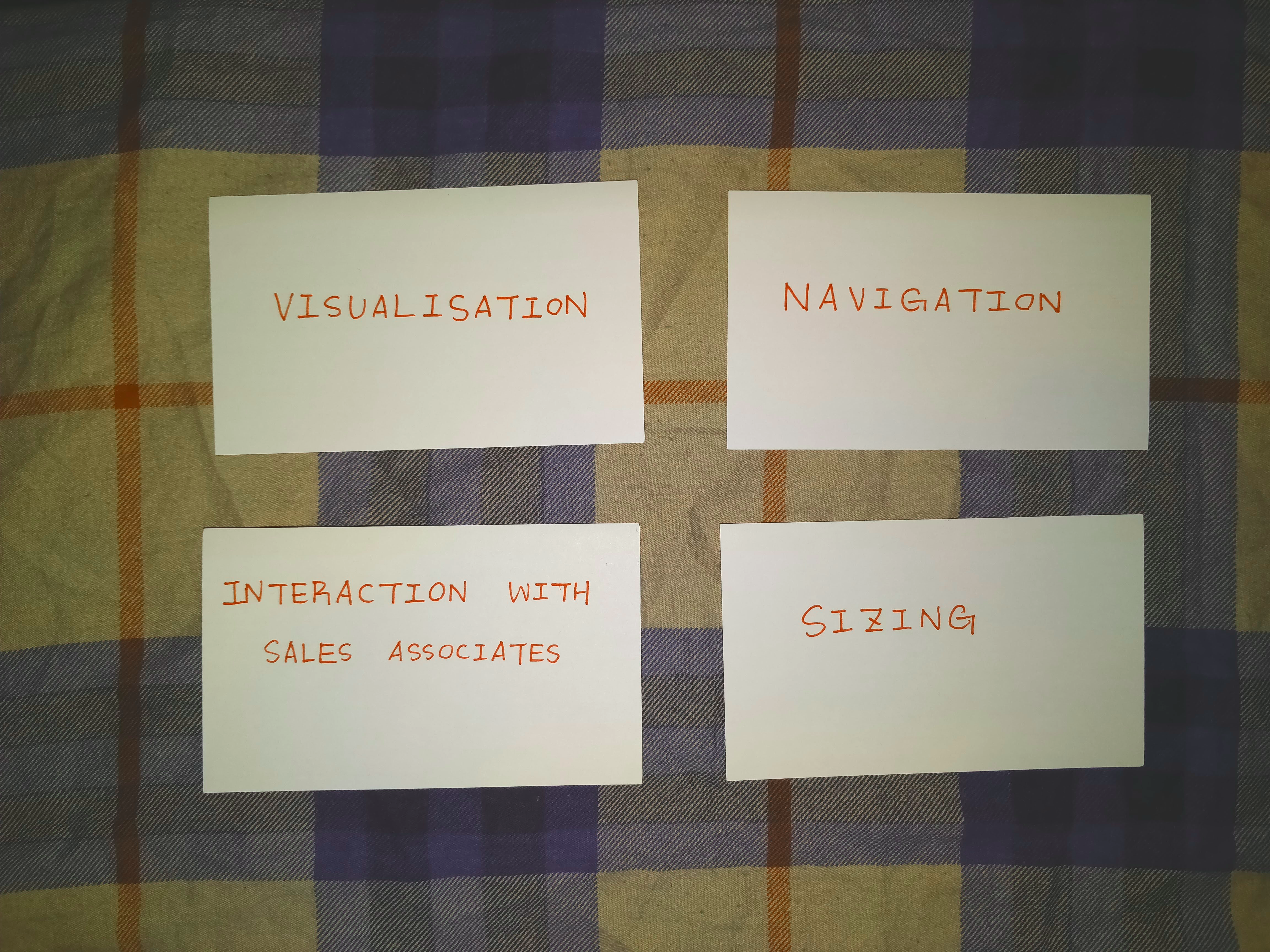
Pain points cards
Mobile App feature list
After the card sorting session, we narrowed down the scope of our application to these 4 major features.
Scan the product to look up details in the application
Customized reviews based on the size details of the user
Customize the fitting experience with sales associate on demand
Request products of different sizes in the fitting room
Quick Wireframing for feedback
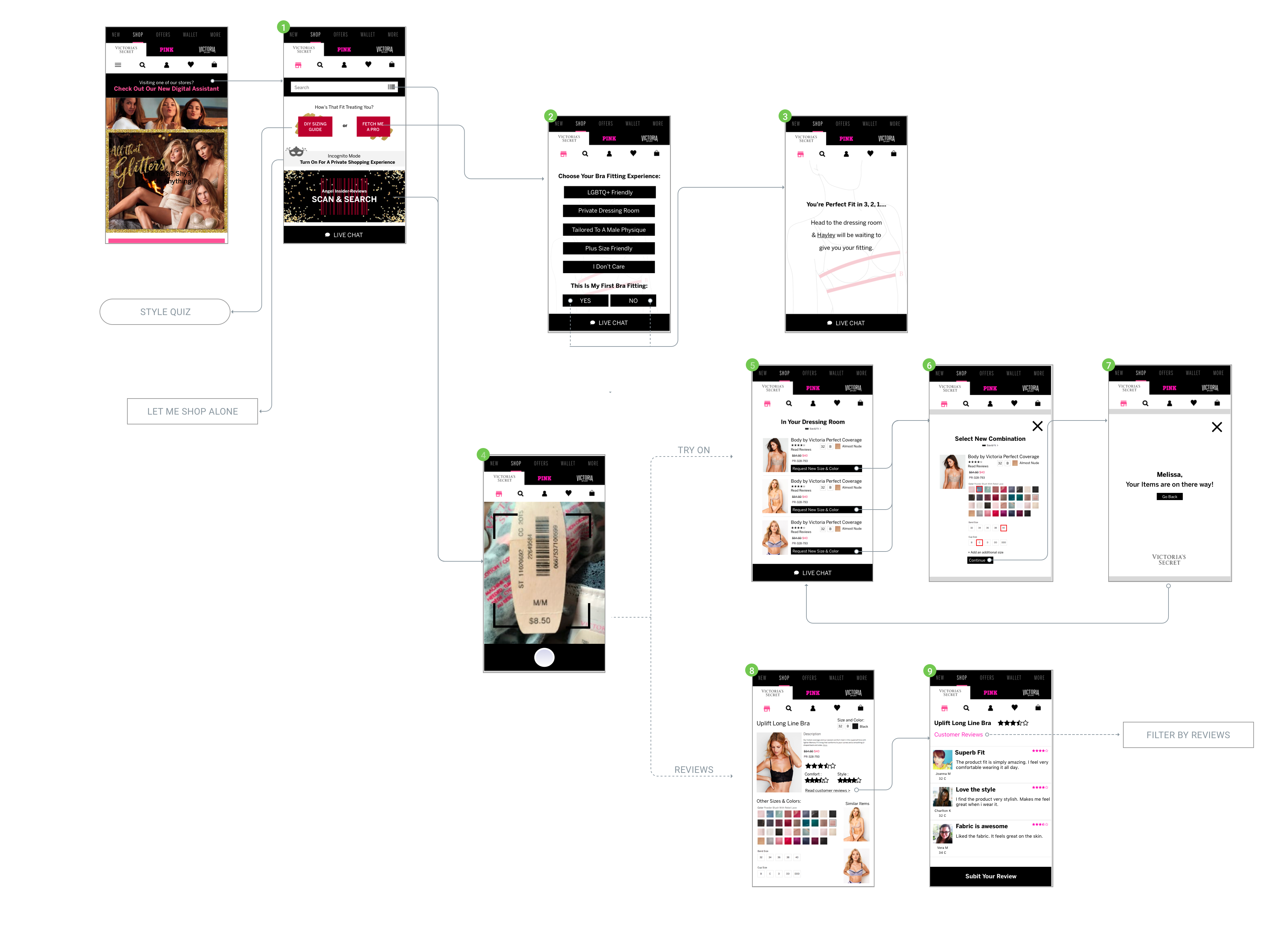
I created a quick wireframe in sketch to get feedback on our mobile app with the features we decided from the card sorting activity.
Final Designs
We conducted 4 feedback sessions which comprised of two cis female participants, one crossdresser male participant and one cis male participant. Based on their feedback, I iterated on the design and came up with the final design.
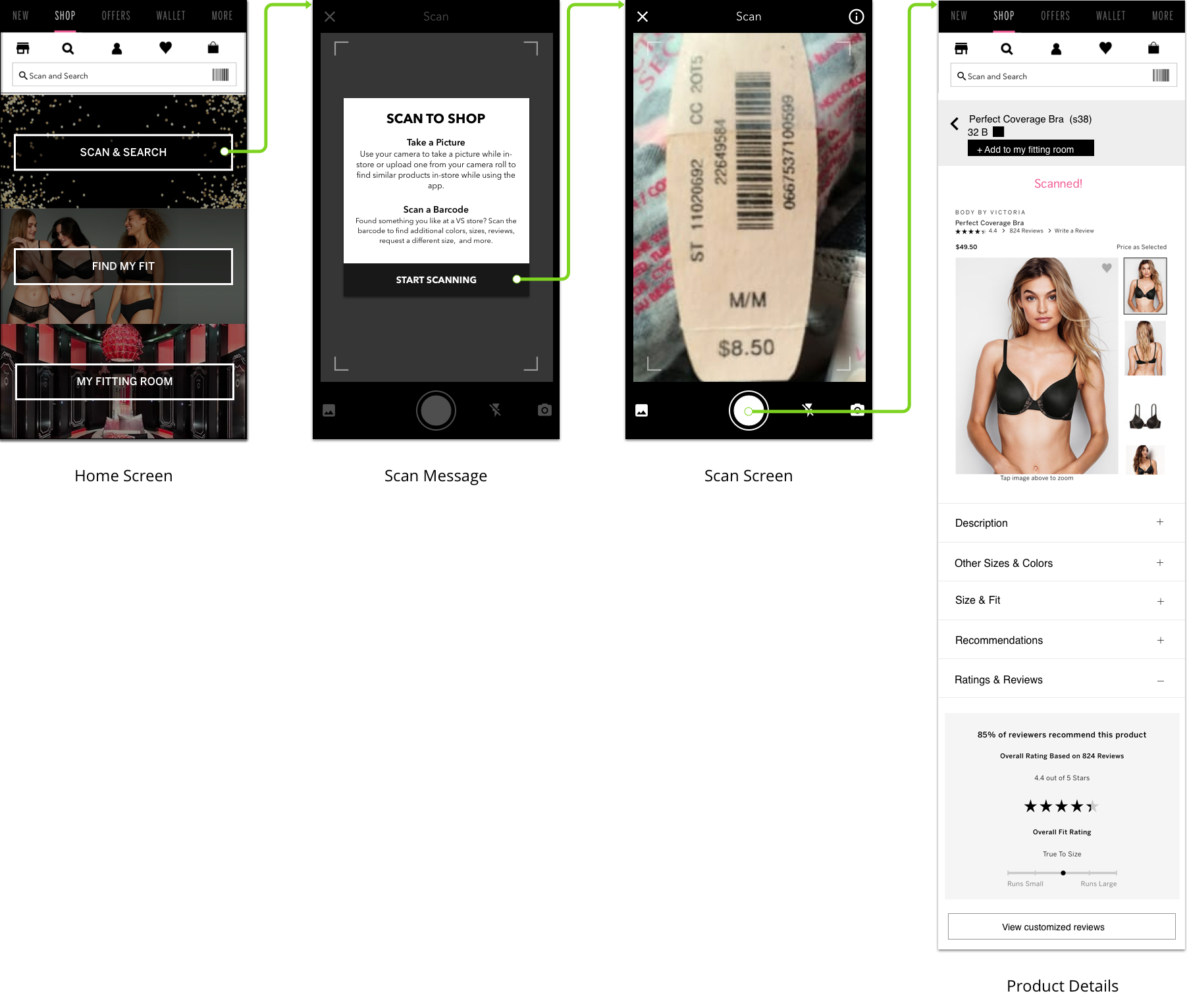
Scan & Search Flow
The scan and search feature allows users to look up the product information of an item in store by scanning the item’s barcode using their smartphone camera.
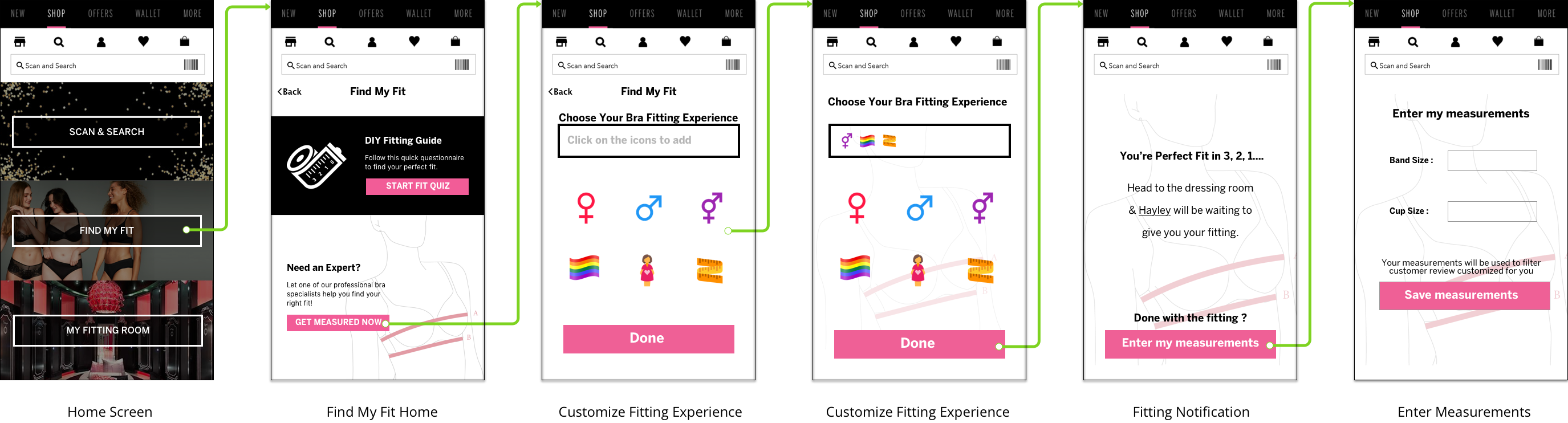
Find my Fit flow
This flow gives users the option to control their own bra-fitting experience by allowing them to choose whether they want to size themselves for a fitting or get help from the Sales Associate.
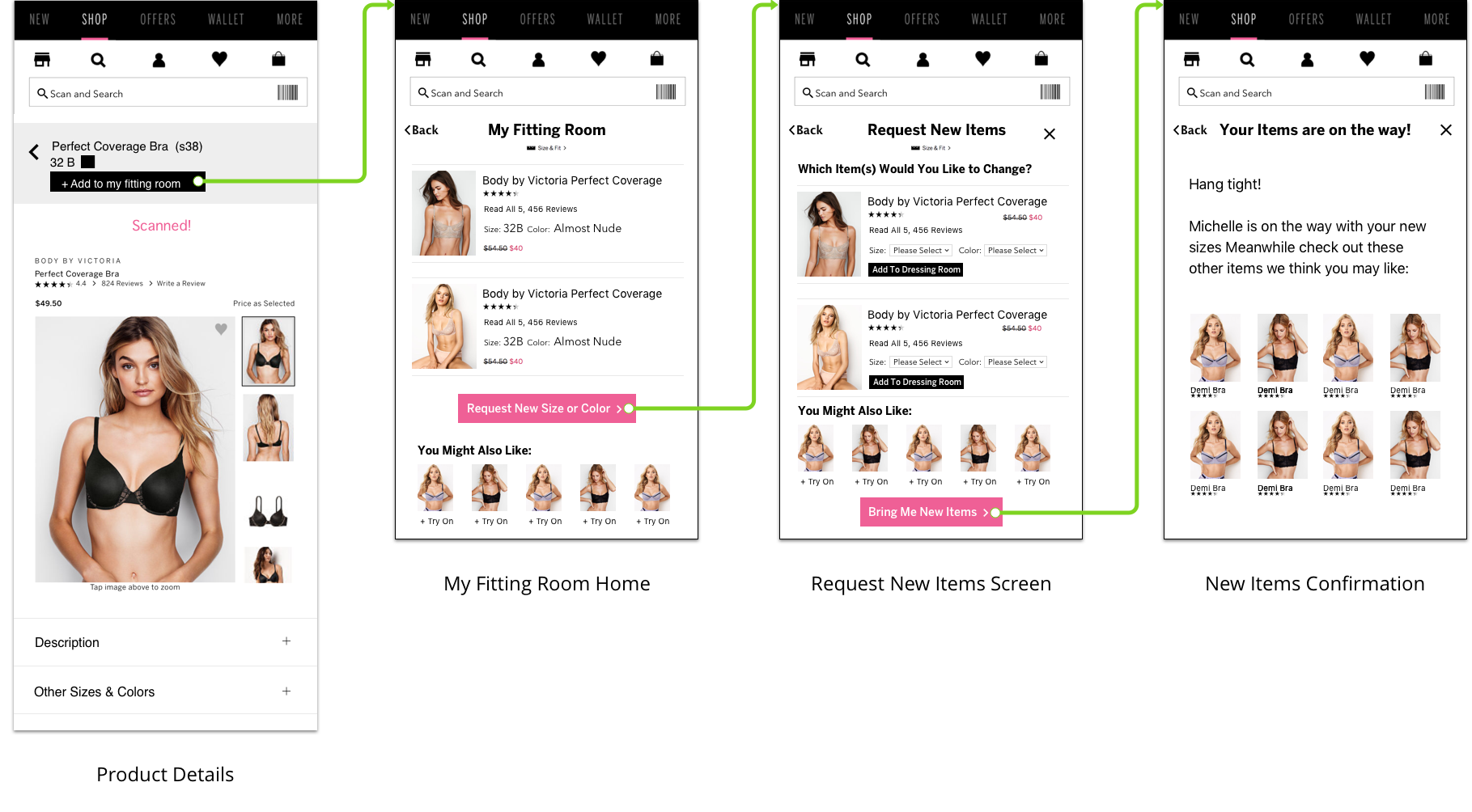
My Fitting Room Flow
This flow describes how the user can add a product to the fitting room in app, which can then be used to request different sized products from inside the fitting room.
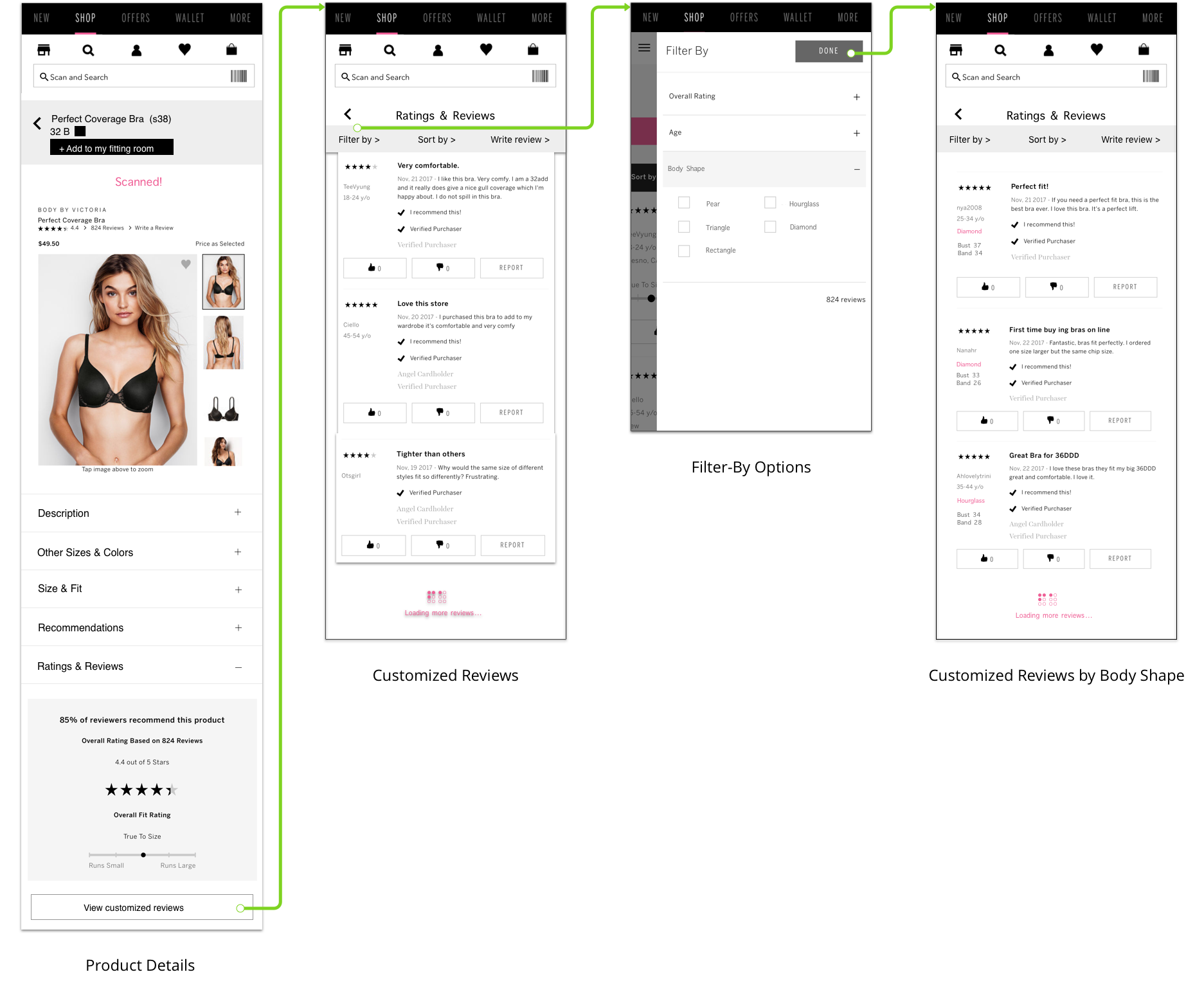
Customized Reviews Flow
This flow describes how the user can see customized reviews based on their measurements if entered, or by filtering products through different categories.
Putting our design through the ultimate test
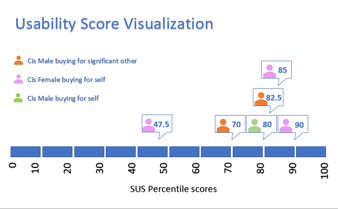
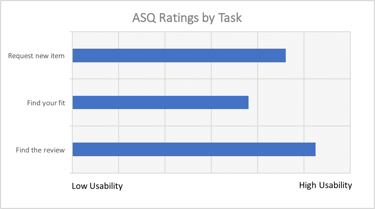
We used a combination of expert and user testing in order to test the performance of our design.
Within these categories we used techniques including Cognitive Walkthroughs, benchmark tasks,
the SUS Scale, and After Scenario Questionnaire (ASQ) and Unstructured interviews in
order to get different types of feedback.
We requested all our participants to follow the Speak Aloud
protocol
to gather additional qualitiative feedback.

My thoughts
This project made me go out of my comfort zone!
Personally for me, this project was a great learning experience as this was a problem scope
completely
out of my comfort zone. I went from a phase from being uncomfortable in a lingerie store, to
understanding
the pain points for others as well and eventually coming up with a design solution to mitigate those
issues.
It indeed was a roller-coaster ride.
Knowing and using the right words is crucial
A good part of research involved with reaching out and interacting with people from the LGBTQ
community.
When dealing with a community who might be going through crises, it is imperative to choose words
appropriately. A huge positive impact on our survey was to run the pre-pilot past a couple of
friends in the LGBTQ community to cross-verify that we were not offending.
The response to this solution made all the effort totally worth it
I acknowledge that there were various time and resource constraints in this project and the problem
we intended to solve is very complicated; but nevertheless we were able to get a positive feedback on
our designs and the biggest takeaway was the general response we got from non-traditional customers
which was that they were at least willing to visit the stores if such a system existed.